Thede facto standard Application Program Interface (API) for TCP/IP applicationsis the “sockets” interface. Although this API was developed for (1) in the early 1960s it has also been implemented on a widevariety of no-Unix systems. TCP/IP (2) Writtenusing the sockets API have in the past enjoyed a high degree of portability andwe would like the same (3) with IPv6applications. But changes are required to the sockets API to support IPv6 andthis memo describes these changes. These include a new socket address structureto carry IPv6 (4) ,new address conversion functions,and some new socket options. These extensions are designed to provide access tothe basic IPv6 features requited by TCP and UDP applications, includingmulticasting, while introducing a minimums of change into the system and providingcomplete (5) for existing IPv4 applications.
(1)A.Windows
B.Linux
C.Unix
D.DOS
(2)A.applications
B.networks
C.protocols
D.systems
(3)A.portability
B.availability
C.calability
D.reliability
(4)A.connections
B.protocols
C.networks
D.address
(5)A.availability
B.compatibility
C.capability
D.reliability
 查看答案
查看答案
IEEE 802.11标准采用的工作频段是 (1) ,下列标准中采用双频工作模式的是 (2) 。
(1)
A.900MHz和800MHz
B.900MHz和2.4GHz
C.5GHz和800MHz
D.2.4GHz和5GHz
(2)
A.IEEE802.11a
B.IEEE802.11b
C.IEEE802.11g
D.IEEE802.11n
PC机不能接入因特网,这时采用抓包工具捕获的以太网接口发出的信息如下: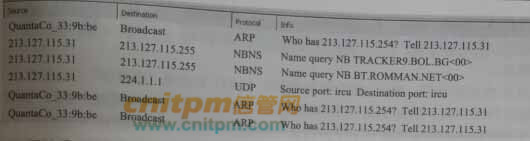
可以看出该PC机的IP地址为(1),默认网关的IP地址为 (2) ,PC不能接入Internet的原因可能是 (3) 。
(1)A.213.127.115.31
B.213.127.115.255
C.213.127.115.254
D.224.1.1.1
(2)A.213.127.115.31
B.213.127.115.255
C.213.127.115.254
D.224.1.1.1
(3)A.DNS解析错误
B.TCP/IP协议安装错误
C.不能连接到网关
D.DHCP服务器工作不正常

 信管网公众号
 信管网订阅号
 收藏
收藏  考试新手指南
 学习计划攻略
 精华备考资料
 案例论文干货
 章节模拟试题
 免费试听课程
 考试信息推送